Chronic Knee Pain: Resolved in 3 Weeks with Oro Muscles
Professional Football Player – Ligue 1A Pain That Had No Clear Source
A professional football player began experiencing progressive pain in his left knee whenever he ran. It started mildly but grew until it forced him to stop mid-session, scoring up to 7-8/10 on the pain scale. After a brief rest, he could resume only for the pain to return. The discomfort was diffuse, mostly lateral, and increasingly frustrating.
Imaging showed no damage. Strength tests were symmetrical. Range of motion was full. On paper, nothing explained why an elite athlete couldn’t complete a standard training run.
When Every Test Looks Normal but Something Still Feels Off
Standard diagnostic ultrasound, MRI, maximal strength testing showed no pathology. Even jump analysis only revealed a mild dynamic valgus, far from a red flag. Temporary relief after soft tissue work suggested involvement of the lateral chain, but results didn’t last.
Clinically, it hinted at a deeper functional issue possibly a gluteus medius endurance deficit, but there was no objective way to confirm it through conventional methods.
Looking Beneath the Surface of Performance
To uncover what wasn’t visible, the therapist turned to the Oro System to evaluate real-time muscle behavior during running.
Sensors were placed bilaterally on the gluteus medius, allowing the healthy side to act as an internal control.
The athlete ran on the field at his usual pace until pain appeared, then continued to maximal tolerable effort. After a short rest, he repeated the run at a lower speed. For the first time, the therapist could visualize how the gluteus medius behaved through fatigue, not just its strength, but its ability to sustain activation over time.
Looking Beneath the Surface of Performance
The Oro data revealed a clear story. During the initial high-speed run, the painful side showed increased activation early on a sign of compensation - movement inefficiency in this context, not power. As the run continued, endurance dropped sharply. By the second, slower run, the athlete had shifted to a bilateral compensatory pattern, redistributing load to maintain pace.
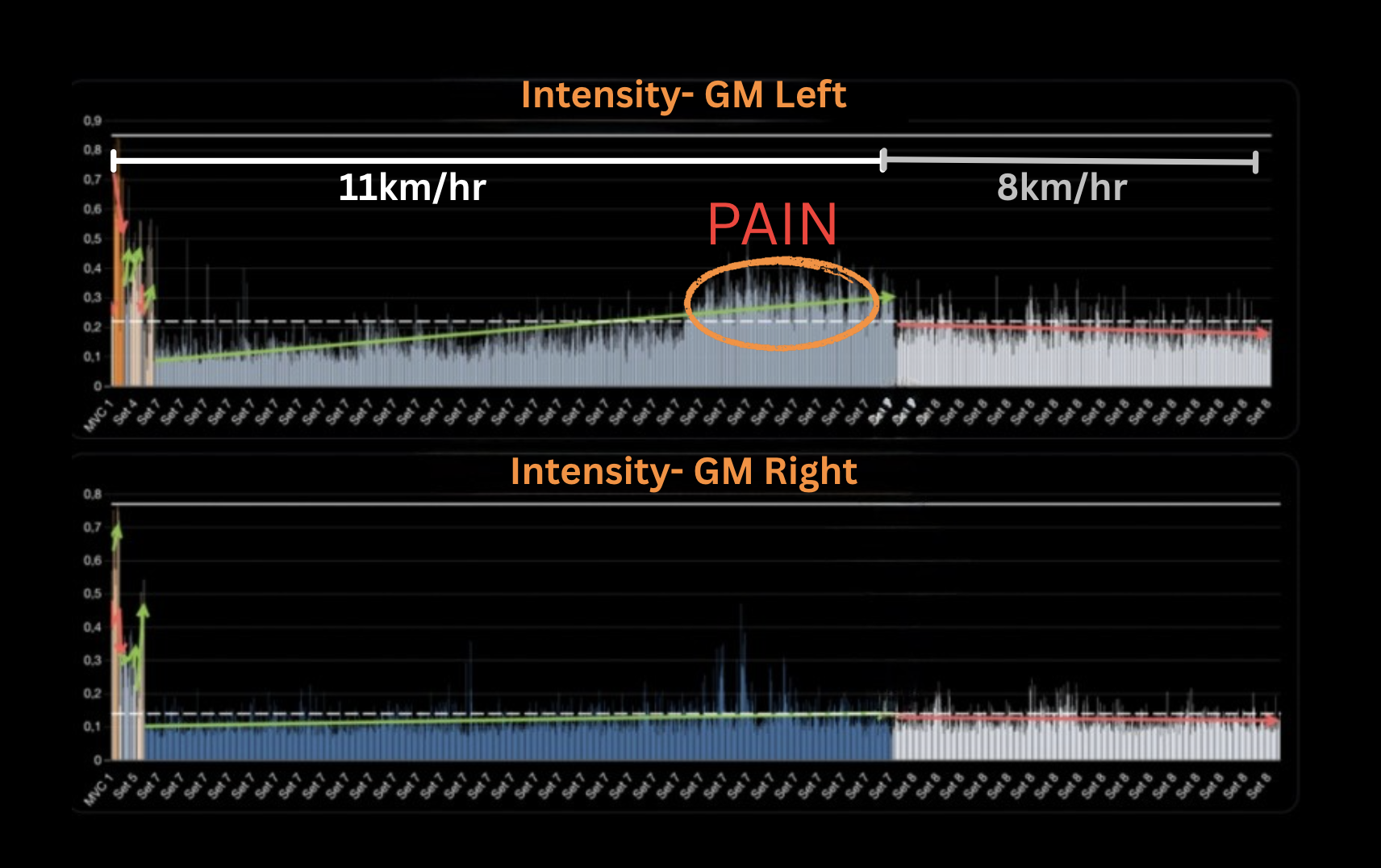
Gluteus Medius (GM) deficit confirmed:
Left GM had a significant ramp up in fatigue at 11km/hr, highlighted by a large ramp in step-by-step, cleaned and normalized intensity compared to the right.
Time-under-tension analysis confirmed the insight: activation symmetry at first, followed by a progressive loss of endurance in the left gluteus medius.
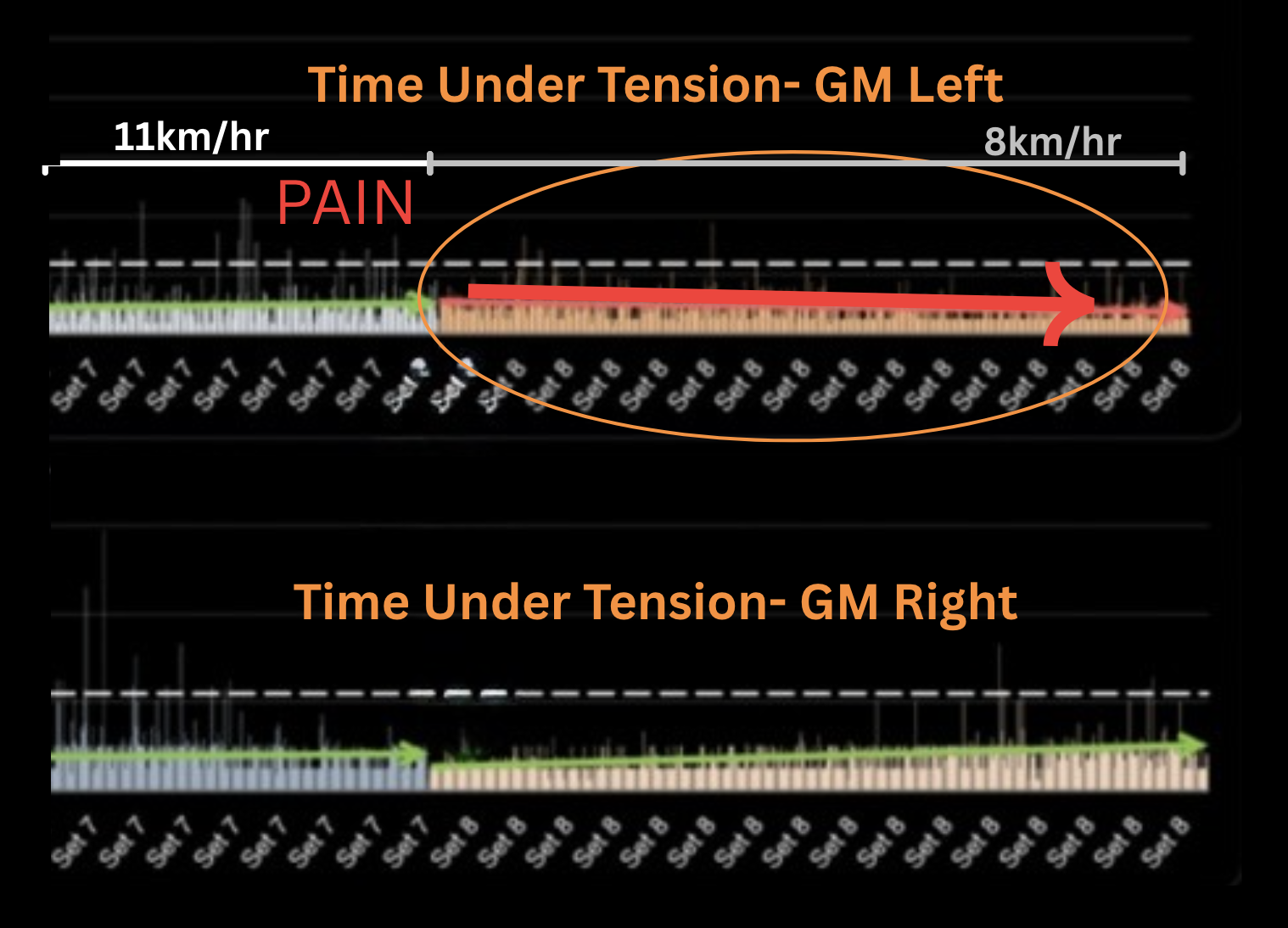
Additional confirmation:
Step-by-step, GM time under tension decreases quickly after pain occurs. Suggests lack of muscle endurance.
What looked like knee pain was in fact neuromuscular fatigue, forcing secondary muscles to take over and creating lateral knee overload.
Rebuilding Strength That Lasts, Not Just Strength That Tests Well
With the root cause identified, therapy shifted from general strengthening to specific endurance restoration.
Long, controlled isometrics were prescribed to rebuild volume capacity in the left gluteus medius, guided by real-time Oro feedback to ensure optimal activation and avoid compensation.
Every session was tracked through Oro Muscles Hub, allowing the therapist to monitor progress objectively adapting workload, tracking time under tension, and visualizing how activation normalized over time.
A Clear Path Back to the Field
Within three weeks, the player returned to full squad training pain-free. Oro data showed restored endurance balance between both sides, and movement patterns normalized.
A preventive follow-up was established, combining a short neuromuscular warm-up and post-session strengthening, again guided by Oro.
The therapist and athlete could both see not just feel that the underlying issue was resolved.
From Guesswork to Guided Progression
This case showed how Oro transforms clinical intuition into measurable science. By tracking both intensity and time under tension, therapists can see when a muscle’s problem is endurance, not power and guide recovery precisely.
For the athlete, it turned frustration into confidence. For the therapist, it turned uncertainty into data-driven decision-making.
This Case Exemplifies
Science: Functional fatigue can exist without structural injury and Oro Muscles helps reveal it.

Impact: Objective insight shortens recovery and supports smarter return-to-play.
Simplicity: Real-time feedback makes complex neuromuscular behavior easy to see, measure, and act on.
Your Turn to Look Beneath the Surface
See how the Oro System helps therapists translate invisible muscle behavior into visible progress improving confidence, reducing recurrence, and accelerating return-to-play.
About Oro
Oro Muscles combines EMG and AI to deliver a new layer of Muscle Intelligence helping clinicians see, measure, and understand muscle function in real time.
Unlike traditional EMG tools that only display raw electrical signals, the Oro System captures, eliminates major sources of signal noise, and normalizes EMG data automatically, instantaneously - adjusting for signal variability between sessions, sensors, and individuals. This normalization allows therapists to compare activation levels over time and between sides with true accuracy, revealing how muscles behave under real movement conditions.
By integrating clinically validated, AI-driven analysis with ISO certified hardware, metrics Oro transforms complex neuromuscular data into actionable insights - actionable Muscle Intelligence. Therapists can objectively detect fatigue, imbalance, or compensation patterns that are invisible to imaging or strength testing guiding precise rehabilitation and confident return-to-play decisions that can be tracked over time.
Simple to use. Scientifically rigorous. Designed to empower clinicians who want to go beyond observation to measurable progress.

Get in touch!
Our team is here to make your journey seamless! If you have questions, you can directly get in contact: